Showing posts with label models. Show all posts

Thursday, May 6, 2010

NATALIA VODIANOVA, WILL YOU STEP UP TO THE PLATE?

Natalia VodianovaRussian model, Natalia Vodianova

Despite attempts to thwart the use of size-0 models, many in the fashion industry have dug in their heels, continuing to send stick-thin models down the runways and slather their images all over the pages of magazines.

One exception is Matan Uziel, Verbmodel, Inc.'s Senior Executive, and Ambassador for the National Eating Disorder Association (NEDA).

Matan Uziel, Verbmodels,Inc.Matan Uziel, Verbmodels, Inc.

"We must do everything we can in order to ensure another model won't fall victim of anorexia. The issue of size zero or "skinny models" has to be dogged by fashion shows and the beauty industry around the world" (Matan Uziel, Verbmodels, Inc.)


On the morning of April 25, 2010, Matan held a press conference on the topic of "Fashion Industry May Be Fueling Eating Disorders In Women," claiming more focus is needed on reducing obsessive dieting, bad eating habits and body dissatisfaction amongst young people around the world, filled with promise and talent.

"It's a mistake to think that Anorexia nervosa among models has somewhat receded, because it's still occurring in fashion industry," protested Uziel. No one is saying fashion causes all eating disorders, but with the fashion industry seemingly pushing for smaller and skinnier models and the press portraying them as something special, there is plenty of blame for an eating disorder and the media can be partially responsible.


Natalia VodianovaNatalia Vodianova by Peter Lindbergh for David Yurman.

When a reporter asked a question regarding whether Uziel thinks that the fashion industry fueling the rise in eating disorders, answered Uziel that "fashion has a bad reputation as a whole, it's notoriously animal unfriendly, and pushes unhealthy body trends to the masses, and there are many people especially in this industry that are responsible for the current situation around the world, but not only them."

Uziel thinks that "it's obvious that a vast change would only come from the inside, where positive role models should take the reins and set a good example on young girls."

One of the more interesting moments came when a journalist asked him if they at NEDA were trying to recruit any top models to spread the word, Uziel replied, "I was trying to contact Natalia Vodianova for many times through the Naked Heart Foundation and different agents in order to ask for her help but I have never heard back and I felt very disappointed and frustrated.

"So, though Vodianova attends the CFDA's panel talks on model health and body image in the fashion industry, she doesn't seem to take any significant, strong positions to fight the rigid body ideals that contribute to body dissatisfaction and eating disorders which is a shame, and on behalf of the National Eating Disorders Association, I urge Ms. Vodianova to take responsibility as a public figure and begin to challenge some of the assumptions that the only way to be beautiful and successful is to be thin," added Uziel.

"The issue of eating disorders can be remarkably fortunate with regard to its celebrity support. And in particular, Vodianova, can help advance the issue in a very specific and much-needed area," he summarized.

So, Natalia, will you step up to the plate?


Links:

http://allaboutmodels.blogspot.com/2009/10/matan-uziel-against-skinny-models.html
http://models.com/feed/?p=748
http://community.livejournal.com/ohnotheydidnt/40004679.html

Follow on Buzz

Tuesday, February 2, 2010

SKIN & BONES: THE MODELS ON LOVE MAGAZINE'S FEBRUARY COVERS

Lara StoneLara Stone

(Click to enlarge all photos)


Gracing the 8 different covers of the February 2010 issue of Love magazine are models Lara Stone, Kate Moss, Naomi Campbell, Kristen McMenamy, Amber Valletta, Natalia Vodianova, Daria Webowy, and Jeneil Williams, all in their birthday suits.

Their nakedness reveals how shockingly thin these young women are. I can only imagine how many young girls will start starving themselves after seeing these photos.


Natalia VodianovaNatalia Vodianova


Naomi CampbellNaomi Campbell


Lara StoneLara Stone


Kristen McMenamyKristen McMenamy


Kate MossKate Moss


Jeneil WilliamsJeneil Williams


Daria WerbowyDaria Werbowy


Amber ValettaAmber Valetta


(Photographs by Mert Alas & Marcus Piggott)


Photos link:

Highsnobiety

Follow on Buzz

Sunday, November 1, 2009

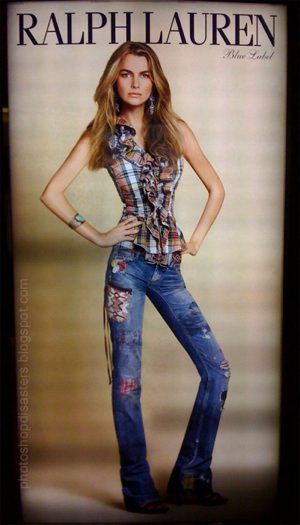
THE SKINNY ON RALPH LAUREN & THE PHOTOSHOPPING DEBACLE...


The controversial photo of Filippa Hamilton by Ralph Lauren


I am late to this party, but just had to weigh in on this controversy.

I've always been a huge fan of Ralph Lauren's beautiful, understated, classic designs. I've bought his clothing for years. So to say that I was appalled by his Art Department's aggressive Photoshopping (Photochopping?) of a picture of Filippa Hamilton, and then learning that the company fired her in April of 2009 for being too fat, is a gross understatement.

Filippa is 23 years old, 5 feet 10 inches, and 120 pounds...a size 4. She had worked as a model for Ralph Lauren for 8 years. 8 years! And out of the blue Filippa was given the news that she was too large for Lauren's clothes. Huh?

Here is the Photoshopped pic of Filippa Hamilton that raised the ire of millions:


And here is how Filippa really looks:


Michael K @ Dlisted said it best:

"Ralph Lauren Fired This Model For Being A Fatty Fat Fatty

You might have already seen the ridiculous Ralph Lauren ad on the left which was Photoshopped by a cross-eyed chihuahua who has a bad case of ADD and a strange fascination with tree branches. After everyone cried "outrage" over the pic, Ralph Lauren issued some half-assed apology saying they take full responsibility...blah..blah...blah. The model in the picture, Filippa Hamilton, doesn't actually look like that in real life. Filippa's head is actually bigger than her hips. Nuts, I know.

At 5'10" and 120lbs, Filippa is pretty svelte, but she still isn't skinny enough for Ralph Lauren. On the Today show this morning, Filippa said Ralph Lauren sent her to the guillotine, because she didn't look like she might fall over if you a blew a kiss at her.

Filippa said, "They fired me because they said I was overweight and I couldn't fit in their clothes anymore. I'm very proud of what I look like, and I think a role model should look healthy." ...

Ralph Lauren confirmed to the NYDN that they pink-slipped Filippa "as a result of her inability to meet the obligations under her contract with us."

Maybe this has something to do with the recession. Maybe the brains at Ralph Lauren think that since people can't buy food, we will all look like malnourished praying (for food) mantises. Not only that, why pay Filippa when they can pull some random kid off the street and give them a couple of Skittles to draw the next Ralph Lauren ad..."


Lauren's apology about the Filippa Hamilton fiasco fell flat when a few days later another photo appeared in a shop in Sydney, Australia featuring model Valentina Zelyaeva. Her body in the photo had been trimmed via the wonders of Photoshop:


Before


After


To hear Filippa talking about her firing by Ralph Lauren on the Today Show, watch this video:


This article in the Daily Mail is also a good read:


A word of advice to Lauren's Art Department: Take some anatomy lessons...STAT.


Links:

http://dlisted.com/node/34359
http://www.boingboing.net/2009/10/06/the-criticism-that-r.html
http://www.msnbc.msn.com/id/33307721/ns/today-today_fashion_and_beauty/

Follow on Buzz

Monday, October 12, 2009

WOULD SOMEONE PLEASE STUFF A SOCK IN KARL LAGERFELD'S PIE HOLE?

Karl Lagerfield
Karl Lagerfield, Creative Director of Chanel, in 2001


Karl Lagerfield continued to spew more vitriol today on the call for a ban on "size zero" models...

"No one wants to see curvy women. You've got fat mothers with their bags of chips sitting in front of the television and saying thin models are ugly. Fashion is about dreams and illusions."


Karl Lagerfield

Lagerfeld on the runway, 2000


How bizarre, especially coming from a man who has forgotten he was once morbidly obese. These days, he looks like he just crawled out of a crypt...

Karl Lagerfield

Lagerfeld, 2009


Lagerfeld's remarks today were in response to the German magazine, Brigitte, reporting last week that it would no longer feature professional models...that "it would only publish photographs of 'real women' after readers complained they could not identify with the models depicted."

And here are a few more of Lagerfeld's bons mots from January, 2009:


Karl Lagerfield Lagerfeld, 2009


"Chanel designer Karl Lagerfeld dismissed "childish" criticism of the fur industry, calling animals "beasts" he has trouble eating meat.

From The Telegraph:

"Hunters in the north "make a living having learnt nothing else than hunting", he said, "killing those beasts who would kill us if they could."

Animals should be killed "nicely" if at all possible, said Lagerfeld, who admitted to being queasy about eating meat.

"I can hardly eat meat because it has to look like something what it was not when it was alive," he said.

Lagerfeld went on to roll his eyes at concerns over eating disorders in the fashion industry.

"In France there are, I think, less than one per cent of people who are too skinny.

"There are nearly 30 per cent of young people who are too fat. So let's take care of the zillions of the too fat before we talk about the percentage that's left."


Two words for you, Karl...ball gag.


Links:
http://www.news.com.au/perthnow/story/0,21598,26198682-5005368,00.html
http://www.huffingtonpost.com/2009/01/02/karl-lagerfeld-defends-fu_n_154873.html

Follow on Buzz

Saturday, July 12, 2008

GERMAN FASHION INDUSTRY STEPS UP TO THE PLATE: NO MORE ULTRA-THIN MODELS


Following the lead of Italy, France, Spain, and the UK, the fashion industry in Germany has signed an agreement that models appearing in ads and on runways must be 16 years old and have a BMI of 18.5.

Let's hope the German fashion industry abides by this agreement. Unfortunately, the fashion industries in the UK, Italy, and France have turned a blind eye to the agreements they signed and continue to use ultra-thin models on the runways.

Here's the news report from Germany:


"German fashion industry says 'no' to anorexic models

July 11, 2008

Underfed models will have no place on the runways or in ads of German fashion houses, according to a voluntary agreement signed on Friday by German fashion industry representatives and sponsored by Germany’s health minister.

The charter requires that models at fashion shows or appearing in advertisements have a body-mass-index of at least 18.5 – a European dress size 36 – and be 16 years old.

"We want to take a clear stand against an unhealthy body image,“ said Health Minister Ulla Schmidt.

The agreement was signed by fashion trade fair organizer Igedo, the industry federation German Fashion, the German Fashion Institute and the Velma federation of licenced modelling agencies.

While the agreement in Germany does not require a doctor’s certificate, as a similar charter in the UK does, Schmidt called it a "milestone“ in the fight against eating disorders. She said she hopes other sectors, such as the advertising industry, will sign on to the agreement, and that it could be the foundation for a Europe-wide charter.

Ana Carolina Reston

Frank Hartmann, director of the fashion trade fair organizer Igedo, called on the industry to show "that dying of hunger is not part of the job.“ The case of Brazilian supermodel Ana Carolina Reston, who died of anorexia two years ago at the age of 21, was a wake-up call to the industry.

Gerd Müller-Thomkins, director of the German Fashion Institute, criticized the "distorted aesthetic ideas“ of designers, who tend to prefer very thin models.

Around 600,000 people between 15 and 35 years of age in Germany suffer from anorexia or bulemia. According to research carried out by the Robert Koch Institute, about 22 percent of young people between the ages of 11 and 17 have some kind of eating disorder. Among 17-year-old girls, the number is 30 percent. One in ten people suffering from anorexia dies from it.

The advertising industry has been strongly critical of Health Minister Schmidt. The Federation of the German Advertising Industry (ZAV) has accused the industry of using populist and misleading arguments and refused to take part in the initiative."

~~~~~~~~~~
To read my previous posts on the fashion industry and their use of ultra-thin models, please click these links:

BONES OF CONTENTION ON THE CATWALK...


ANA CAROLINA RESTON: SHE WAS YOUNG, BEAUTIFUL & STARVED TO DEATH


HOW MANY MODELS HAVE TO DIE ?


ARE THINNESS LAWS TOO HEAVY-HANDED?


FRANCE TABLES NEW "ANOREXIA" LAW


ABC NEWS FLASH !!! GOOD MORNING AMERICA and 20/20 REPORT ON THE DEADLY KIMKINS DIET SCAM, HEIDI DIAZ/KIMMER and ANOREXIA NERVOSA


The Guardian also has an excellent article about Ana Carolina Reston here:

http://lifeandhealth.guardian.co.uk/fashion/story/0,,1987945,00.html


LINK:
http://www.thelocal.de/13023/20080711/

Follow on Buzz

Sunday, June 29, 2008

A BUM RAP: OUTRAGEOUS ATTACKS ON KAROLINA KURKOVA FOR BEING "TOO FAT"


Karolina Kurkova walks the runway on June 18, 2008, during the Cia Maritima show in Sao Paulo, Brazil


With both designers and the fashion industry moving away from "size 0" models, the recent attacks on Karolina Kurkova for being "too fat" are simply outrageous.

Last week, during the Cia Martima show in Sao Paulo, Brazil, the Brazilian press skewered 24-year-old, 5' 11" Karolina Kurkova, Czech supermodel and model for Victoria's Secret, for being "too fat" for the catwalk, reporting that audience members were "shocked" when they saw "cellulite on her butt."

Ralph Lauren, Chanel, and Balenciaga have used Karolina in many of their ad campaigns, and her photos have graced the pages of fashion magazines worldwide.

Karolina Kurkova

The Brazilian press lambasted her for showing "back fat," "love handles," and "cellulite" while wearing a bikini for Cia Martima during Sao Paulo Fashion Week.

Ana Carolina Reston


This is especially troubling in light of the fact that another Brazilian model, Ana Carolina Reston, died at the age of 21 from anorexia on the eve of photoshoot in Paris. At the time of her death, she weighed only 88 pounds.

Uruguayan fashion models and sisters, Luisel Ramos, 22, and Eleana* Ramos, 18, both died from complications of anorexia.

Luisel Ramos

Luisel Ramos

Luisel Ramos

Eleana Ramos

Eleana Ramos


Luisel had consumed only lettuce leaves and Diet Coke for three months, after being told she could be an international sensation if she lost weight. Luisel suffered a heart attack moments after stepping off the catwalk at a hotel in Montevideo in August of 2006. Luisel's father told police that Luisel had not eaten at all for "several days" before she died.

*NOTE: I have just learned that it has been incorrectly reported by the international press that Eleana's first name was "Eliana." It is, in fact, "Eleana."

Eleana Ramos, also known as Elle Ramos, worked for Pancho Dotto Models, a renowned modeling agency in Argentina. In February of 2007, Eleana was found dead at the home of her grandparents in Montevideo, Uruguay, of a heart attack. At the time of her death at age 22, she weighed only 98 pounds which, given her height of 5' 9", gave her a BMI of only 14.5.

Photo from AP Photo by Marcelo Hernandez

Luis Ramos cries during the funeral of his daughter Eliana Ramos in Montevideo, Wednesday, Feb. 14, 2007. Model Eliana Ramos was found dead at her home Tuesday, six months after her sister Luisel Ramos, 22, another model, died of a heart failure while participating in a fashion show in Montevideo on August 2006.


With the tragic deaths of Luisel Ramos and Ana Carolina Reston, Madrid began banning models with BMIs of less than 18.5.

Let's hope that the ban of "size 0" models will be adopted worldwide so that a model with a healthy BMI will not suffer the scourge of the press and others for looking "too fat."

And for a trip down memory lane...


REMEMBERING WHAT ONCE WAS THE BODY IDEAL...


TO READ THESE PREVIOUS POSTS, PLEASE CLICK:

BONES OF CONTENTION ON THE CATWALK...

ANA CAROLINA RESTON: SHE WAS YOUNG, BEAUTIFUL & STARVED TO DEATH

HOW MANY MODELS HAVE TO DIE ?


LINKS:
http://www.thefashionspot.com/forums/showpost.php?p=4640915&postcount=3543
http://www.news.com.au/entertainment/story/0,26278,23916099-5007192,00.html
http://www.modelsblog.info/2006/08/21/in-memory-of-luisel-ramos/
http://www.modelsblog.info/2007/02/14/stop-this-absurdity-luisels-sister-eliana-ramos-dies-of-malnutrition-too/
http://allwomenstalk.com/heart-attack-kills-model-eliana-ramos-sister-of-luisel-ramos/
http://www.fashionmodeldirectory.com/models/eliana_ramos/showphoto/80768

Follow on Buzz

Friday, June 20, 2008

BONES OF CONTENTION ON THE CATWALK...


Brazilian model, Ana Carolina Reston, participates in a fashion show in Belo Horizonte, Brazil, on April 14, 2005. Reston, a 21-year-old anorexic model who weighed only 88 pounds died on Tuesday Nov. 14, 2006 of complications related to anorexia nervosa (AP Photo/Eugenio Savio)


"Should ultra-skinny models be banned? The fashion industry claims it is being unfairly pillaged for the 'size 0' phenomenon. But self regulation has done little to weed out emaciated models.

"They have to understand that being thin is our job", states one size 0 model.

But following the death of anorexic model, Ana Carolina Reston, designers are coming under pressure not to use skinny models. Spain banned ultra-thin models from Madrid Fashion Week after complaints they encouraged anorexia.

"We didn't want teenagers to think excessive slimness is a model of beauty", explains organizer Cuca Solana. But other fashion capitals refuse to follow Spain's lead.

"The whole size 0 thing has come from Hollywood not the catwalks", complains Hilary Riva, Chief Executive of London Fashion Week. "It's too simplistic to blame fashion..."


Alice McCall


Australian designer, ALICE McCALL, reveals herself to be one idiotic twit in the video when she compares starving people in Africa to models suffering from eating disorders.

To view my previous posts on Ana Carolina Reston, please click here:


ANA CAROLINA RESTON: SHE WAS YOUNG, BEAUTIFUL & STARVED TO DEATH


To read more about Ana Carolina Reston and other models who have died from anorexia and/or bulimia, please click on the links below:


HOW MANY MODELS HAVE TO DIE ?


ARE THINNESS LAWS TOO HEAVY-HANDED?


FRANCE TABLES NEW "ANOREXIA" LAW


ABC NEWS FLASH !!! GOOD MORNING AMERICA and 20/20 REPORT ON THE DEADLY KIMKINS DIET SCAM, HEIDI DIAZ/KIMMER and ANOREXIA NERVOSA


The Guardian also has an excellent article about Ana Carolina Reston here:


http://lifeandhealth.guardian.co.uk/fashion/story/0,,1987945,00.html


LINKS:

http://www.youtube.com/watch?v=NJt4YvBQ3p8 http://urbanfashionista.wordpress.com/2008/04/16/look-book-alice-mccall/
www.daylife.com/photo/0faYeJW0k77eK

Follow on Buzz

Saturday, April 19, 2008

ARE THINNESS LAWS TOO HEAVY-HANDED?


The death on November 15, 2006 of anorexic model Ana Carolina Reston has those close to her hoping the fashion industry will finally wake up to the dangers of the eating disorder.

Reston, 21, a Brazilian model who weighed only 88 pounds at the time of her death, succumbed to a generalized infection caused by anorexia nervosa, officials at Sao Paulo's Servior Publico Hospital said.

~~~~~~~~~~

Yesterday, I linked to MrsMenopausal's blog, Weighing the Facts, and her post focusing on We Bite Back, a post-pro-anorexic website created by Sharon Hodgson. Sharon was interviewed and is quoted in the following excellent article which appeared in today's edition of The Globe & Mail:

"Moved by concerns over skinny models, countries have begun the controversial measure of applying legislation to the catwalks


by SIRI AGRELL
April 19, 2008

When Brylie Fowler was choosing models for a fashion spread in the second edition of her London-based magazine, Plastique, she settled on a girl whose portfolio indicated that she had a healthy, athletic frame.

But Ms. Fowler, who grew up in Oakville, Ont., said the model who arrived had a 23-inch waist and was so tiny that she resembled a baby deer as she struck the exaggerated poses of high fashion. The resulting photographs of her in a Dolce & Gabbana gown, Ms. Fowler said, were too frightening to print.

And so the magazine decided to use a common industry technique, airbrushing the image before it went to press to change the girl's appearance.

Except in this case, it made her bigger.

"It doesn't look good," Ms. Fowler said yesterday of emaciated frames. "And I'm in the business of making things look good."

The fashion industry is having a similar image crisis these days. It has been accused of promoting extreme thinness for decades, finally leading several countries to take legislative action.

This week, France introduced a law that would make it a crime to "incite" people to thinness on websites, magazines and in advertisements. In 2006, Spain announced that models must have a minimum body mass index, or height-to-weight ratio, of 18, or be banned from the runways.

And some haute couture heavyweights seem to be taking note. In the April issue of Vogue, the Prada-wearing devil herself, Anna Wintour, encouraged designers to "consider athleticism and vitality as assets in the wearing of great fashion."

But is the fashion world simply paying pouty lip service or is the industry that gave us skinny jeans and standardized size zero really ready to declare that thin is out?

"People don't even really believe it; there's not any fear," said Ms. Fowler, who began her career at the Paris magazine Citizen K. "Is this law really going to change anorexic girls out there? Are we not going to take photos of Mary-Kate Olsen?"

Skepticism of the law and its impact has been expressed by fashion insiders around the globe.

French designer Jean-Paul Gaultier was quoted as saying: "This kind of problem cannot be resolved with laws," a sentiment repeated in Canada.

In October, a group of fashion designers from Milan, Italy, attended the L'Oréal Fashion Week in Toronto and asked Fashion Design Council of Canada president Robin Kay to sign a pledge not to use skinny models in the shows. She refused.

"I said I couldn't do it," she recalled yesterday. "I can have an opinion, but I'm not going to sign that. I have not seen a need for it on our runways."

Jeanne Beker, host of Fashion Television, said she understands the impetus behind the French legislation, but not how the government plans to enforce it.

"I find it very strange that people are trying to legislate an aesthetic," she said. "We don't want to promote unhealthy images, but who's to say what's really healthy? How would it look if people over a certain weight couldn't be shown?"

Ms. Beker believes the French law, if it is ultimately passed, would be a form of censorship. But more than that, she suggests that eagerness to blame fashion for eating disorders is a cultural witch hunt akin to demonizing gangster rap or violent video games.

Fashion is a business, she said, but also a fantasy, one that is produced at great effort with the explicit purpose of being non-representative.

"These images are not to be taken literally," she said. "At every photo shoot there are 50 people scurrying around trying to get that girl to look like that. It's a fairy tale."

But the problem with the fantasy defence, critics say, is the very real nightmare of women who take those images to heart, and who carve their bodies down to unnatural sizes and unhealthy states while studying the pages of Vogue.

In 2006, Brazilian model Ana Carolina Reston died of anorexia-related illness at the age of 21 and a weight of just 88 pounds. Months earlier, 22-year-old Luisel Ramos walked off a runway in Uruguay and dropped dead from massive heart failure, also the result of starvation.

Images of the two women can be found among pictures of celebrities, such as the Olsen twins, Kate Bosworth and pre-pregnancy Nicole Richie on the so-called pro-anorexia, or "pro-ana," sites that propagate on the Internet. The French legislation also promised to crack down on these sites, where "thinspiration" photos are shared by anorexics ("anas") and bulimics ("mias") along with pictures that chronicle their own starvation.

"Imagine standing in front of the bathroom mirror and taking pictures of your abdomen every day and doing so because you want to compare all the photos to see if your efforts have led to any change," said Sharon Hodgson, a 30-year-old Web designer who lives in Halifax. "It's a recipe for insanity."

Having developed anorexia as a teen, a reaction to stress at school, she says, Ms. Hodgson entered the world of pro-ana sites in her 20s, and was soon working as a moderator on one called Miana, which has since been shut down.

Like many people who suffer from an eating disorder, she saw her weight as something over which she could exercise control, and she sought others online who "understood that coping mechanism."

The Internet was a place to trade tips and thinspiration photos, but also a vehicle to chronicle her disease, the very presence of other users acting as an incentive to push herself further toward death.

But, like the upper echelons of the fashion world to which she aspired, Ms. Hodgson said pro-ana sites are elitist, and one of her jobs was to keep out new members.

"You become strangely protective about not wanting other people to learn an eating disorder," she said.

In 2006, Ms. Hodgson went to a walk-in clinic and admitted to her disorder, only to be placed on a waiting list and never contacted again.

She now runs a website called webiteback.com that she describes as "post pro-ana," a recovery group that allows women to track their improving health instead of their downward spirals.

Creating the site helped her get healthy and she would like to see more education programs and community support for women with eating disorders.

But the French law makes her nervous, especially the move to criminalize pro-ana sites.

If she had been contacted by authorities during her days as a site moderator, Ms. Hodgson said that being treated as a criminal would have been devastating to her mental health.

"I wasn't very stable emotionally and it wouldn't have been pretty. I might have done something stupid or rash," she said. "It sounds like they're just going to throw all the mentally ill people in jail."

Stories like Ms. Hodgson's have prompted many health experts to support legislative action as a necessary next step.

Anne Elliott, the program director of Sheena's Place, a Toronto eating-disorder clinic, said there is no real divide between the world of fashion and those who consume it.

Sheena Carpenter, for whom the clinic was named, was told by a modelling agency at age 15 that her face was too wide and that she should investigate plastic surgery. She died in 1993, weighing just 50 pounds. If society isn't going to address that reality, Ms. Elliott said, perhaps the government should.

"How else is it going to change?" she asked.

Dr. Hany Bissada, of Ottawa's Regional Centre for the Treatment of Eating Disorders, also supports the French legislation.

"I think it's a step in the right direction," he said. "It's not legislating weight; it's putting a minimum level of health for people to be able to participate in this industry."

Dr. Bissada believes that women with a BMI below 18, the threshold for starvation, should not be allowed to model.

"I would love to see that enforced in Canada," he said. "I'm not asking for jail time, but a fine would be good enough."

Penny Priddy, an MP with the NDP who has long followed health issues, said she does not believe legislative action is realistic, and believes more resources should be given to educating young people about positive body image.

"I don't know whether it would withstand a constitutional challenge or whether this would be considered censorship," she said. "Are you then going to say there can be no websites that can advertise how to gamble or mix a drink?"

From her experience in the world of fashion, Ms. Fowler does not believe that BMI is an adequate indicator of health. She knows many of the fashion it-girls held out as examples of extreme thinness, and said their body shape is the natural result of genetics and their young age.
Setting a mandatory minimum BMI in Spain had only one effect, she added. Models stopped travelling to shows there.

"I don't want anyone to suffer for fashion, but I don't think the law should come into it," she said. "The onus should be on the agency to make sure the girls they provide are healthy."

At least one agent is doing so.

Next month, Ben Barry, who owns a Toronto modelling agency, will lead a team of researchers in an international study as part of his PhD research at Cambridge University in England.

Mr. Barry's agency represents models of various racial backgrounds, heights, sizes and ages, and while his advocacy has landed him on The Oprah Winfrey Show, he said the industry-wide resistance to more inclusive images is palpable.

Although Dove, a beauty-products company, has had tremendous success with its "campaign for real beauty," which employs "real" models, Mr. Barry said, many do not believe that regular-sized women can be used to promote luxury brands.

To see whether this is true, his team will survey thousands of women in England, Canada, the United States, India, China and Brazil about how models of "traditional" and "plus" sizes affect their shopping habits and brand loyalty.

He hopes his results will make the fashion world take note, but until then, he doubts anything will change.

"As long as we approach this from a health-care perspective or a government perspective, change is not going to occur," he said. "Fashion is a business, and if we're going to make change, we have to use the language of business."


Anorexia: Criteria

The following are the American Psychiatric Association's published criteria for diagnosing anorexia nervosa.

Refusal

Refusal to maintain body weight at or above a minimally normal weight for age and height. (For example, weight loss leading to body weight less than 85 per cent of that expected; or failure to make expected weight gain during period of growth, leading to body weight less than 85 per cent of that expected.)

Fear

Intense fear of gaining weight or becoming overweight, even though patient is underweight.

Denial

Disturbance in the way in which one's body weight or shape is experienced, undue influence of body weight or shape on self-evaluation, or denial of the seriousness of the current low body weight.

Missing periods

Amenorrhea in postmenarchal females. (That is, the absence of at least three consecutive menstrual cycles. A woman is considered to have amenorrhea if her periods occur only after hormone administration.)

>>American Family Physician

Anorexia: Consequences

A body suffering from anorexia nervosa is denied the nutrients it needs to function normally. To conserve energy, the body slows down, causing medical problems.

Heart

Abnormally slow heart rate and low blood pressure. The risk for heart failure rises.

Bone

Reduction of bone density, which results in dry, brittle bones.

Muscle

Muscle loss and weakness.

Kidneys

Severe dehydration, which can result in kidney failure.

Energy

Fainting, fatigue and weakness.

Hair and skin

Dry hair and skin; hair loss is common.

Growth of a downy layer of hair called lanugo all over the body, including the face.

>>National Eating Disorders Association, www.nationaleatingdisorders. org


Body image and eating disorders

The results of a 1995 study show that women, when asked about their shape and what is considered ideal, consistently rated themselves as much heavier. Responses in men have shown that their ideas of attractive and actual are at about the same point. BMI stands for body mass index.

7 million women in the U.S. suffer from eating disorders, according to the National Association of Anorexia Nervosa and Associated Eating Disorders.

10% report onset of illness at 10 years or younger.

2% of Canadians are considered to be underweight.

18...

BMI below which doctors consider a person to have an eating disorder.

27...

Average Canadian BMI score.

38.9% of Canadians are considered to be a normal weight (18.5 to 24.9 BMI score)

59.1% of Canadians are considered to be overweight or obese.

SOURCE: STATISTICS CANADA, ANAD.ORG, FEMALE FEAR OF FAT , FALLON AND ROZON STUDY (1985)


Click on the following links to read more about anorexia, bulimia, lanugo, Ana Carolina Reston, Luisel Ramos, France's new anorexia law, Sharon Hodgson & We Bite Back:


WARNING TO ANOREXICS: LANUGO IS NOT PRETTY


ISABELLE CARO and ANOREXIA: HER TRAGIC CHILDHOOD & HER CURRENT STRUGGLE TO SURVIVE...


HOW MANY MODELS HAVE TO DIE ?


THE DEADLY KIMKINS DIET & EATING DISORDERS...


KIMMER...MEET ISABELLE CARO...


FRANCE TABLES NEW "ANOREXIA" LAW


WE BITE BACK !


LINK:
http://www.theglobeandmail.com/servlet/story/LAC.20080419.THIN19/TPStory//?pageRequested=all
http://www.people.com/people/article/0,26334,1560633,00.html

Follow on Buzz

Friday, March 7, 2008

REMEMBERING WHAT ONCE WAS THE BODY IDEAL...

HOW DID WE GO FROM THIS...


MARILYN, a size 14...

TO THIS, a size 0?


Who is responsible for the shift in perception of the "ideal" body for women during the past 40 years? Well, the answer is a no-brainer: The fashion industry.

From the emergence of Twiggy in the Swinging '60s to the skeletal models in magazines and on the catwalk these days, designers continue to fashion their clothing to fit their perception of the ideal body, citing that their clothes "hang and look better" on their model muses who are, almost without exception, rake thin.


According to Women's Wear Daily in the UK , size zero is the best selling size among the top-ranking fashion labels.

And because of the recent ban on size-zero models on some (but not all) runways, many designers and their financial backers have railed against the ban, saying that it interferes with their artistic process and business.

It is a shocking situation that I'm afraid isn't going to go away any time soon.

Remember when curves were beautiful?


LINKS:


http://www.amoeba.com/blog/tags/madonna/page1.html

http://www.piercemattie.com/blogs/industry_news/

http://youtube.com/watch?v=TMIQf8b9iEo&feature=related

Follow on Buzz

Thursday, February 21, 2008

HOW MANY MODELS HAVE TO DIE ?

Photo by Richard Avedon


From The Times of London

"February 20, 2008

Slim pickings on the model front

Ultra-thin is still in, and there’s not much super about the models at Milan Fashion Week

Lisa Armstrong, Fashion Editor

During Milan Fashion Week last September, a headline-provoking image of an anorexic model’s naked 4st 12lb (31kg) frame was stretched provocatively (and distressingly) across numerous billboards. The label involved issued a statement saying that it had deliberately chosen her to bring home the distorted body messages transmitted by fashion. Measured by the column inches gained, the shock tactic was highly effective, though in advertising the message is always undermined to an extent by the motive – especially in Italy, where paying lip service comes more easily than paying taxes.

Maybe that’s why, despite officially banning – along with Madrid Fashion Week – models with a body mass index (BMI) below 18, nothing has really changed on the catwalks here. There are still shows by established designers featuring cadaverous bodies that would no longer be tolerated in London – although, ironically, the latter has not adopted the ban (as The Times reflected in a leading article last week). Instead, the British Fashion Council has put into place several regulations which – and here I disagree with last week’s criticism – are ultimately more thoughtful and practicable than a headline-grabbing and arbitrary clampdown on BMIs, including enforcing an age limit (no girls under 16), policing backstage areas for drugs (zero tolerance) and establishing a models’ union.

The headline image this week may well prove to be the one shown above, from an exhibition of Richard Avedon’s work that has just opened in Milan, sponsored by Versace. In days of yore, Avedon’s collaboration with the supermodels for Versace’s ads became as much a part of the wallpaper of the 1990s as Oasis and Blur were the soundtrack. But there are no supermodels now, only (mainly) anonymous Eastern Europeans who, besides being built differently from the supers (who were thin but not emaciated), exude a kind of dislocated isolation as opposed to the supers’ imperious sexiness. The Eastern Europeans are less prone to diva behaviour and more likely to accept lower pay and inferior working conditions. As for using men as footstools and sofas, what would be the point? They wouldn’t be able to weigh them down, nor be convincing as women in charge. "


~~~~~~~~~~


I came across the Times of London article while reading my newspaper this morning. The first thing that jumped out at me was the reference in the first paragraph to the "headline-provoking image of an anorexic model’s naked 4st 12lb (31kg) [68 pounds] frame was stretched provocatively (and distressingly) across numerous billboards."


That "anorexic model" is Isabelle Caro....


After reading the entire article, I was shocked as I was under the impression that the fashion industry had clamped down on using emaciated models who had a BMI below 18. To now read that they were still on the catwalks in the UK and Europe shocked me...

And then I remembered a startling article and video I had stumbled upon a few weeks ago.

It is heartbreaking.


"Did Model Die From Pressure to Be Thin?


Photographer Blasts Fashion Industry for Promoting Skinny Models, Pushes for Reforms


Fashion photographer Adi Barkan is shown cradling Hila Elmalich in a still from a video shot when the model fell ill. (Gil Sadan/Tamar Golan Film)


By SIMON MCGREGOR-WOOD and KAREN MOONEY

JERUSALEM, Israel, Nov. 19, 2007 —


When Israeli fashion model Hila Elmalich died last week after years of fighting anorexia, she weighed less than 60 pounds. Her death sent a shockwave through Israel's fashion world.

Elmalich, who had been in and out of hospitals for several years, collapsed at home and died Wednesday of heart failure.

The Israeli fashion photographer and modeling agent Adi Barkan was her friend. He spent hours at her bedside over the years. "I don't know how to feel, I don't know what to say," he told ABC News Monday. "It's still too fresh."

For the last three years Barkan has been campaigning against the fashion industry's use of super thin models. He now refuses to use models whose body mass index is less than 19. The BMI is an internationally recognized measure of a person's weight in relation to their height.

[Calculate your body mass index at the National Institutes of Health site: http://nhlbisupport.com/bmi/.]

Barkan led the charge against the pressure on models to be ultra-thin, and in 2004 Israel became the first nation to pass laws requiring modeling agencies to hire only healthy models who have a body mass index -- a measure of body fat -- of 19 or above. That means that a 5'9" woman would have to weigh at least 129 pounds.

Barkan is convinced from his own experience working in the industry that young models are under intense pressure to lose weight. "In Israel we lost several sizes in 10 years!" he said, "when I was shooting fashion 10 years ago models were size 38, now it's 32 or 34."

Two years ago ABC News visited Adi at his studio in Haifa where he was working on a sporting catalogue. The three teenage models on the set were clearly in good health. He had just judged a national modeling competition and was shocked at the number of teenage girls who were under weight.

He is also campaigning internationally to change attitudes in the fashion world. "They say a lot but they did nothing yet, so let's do it! Because from talking nothing will move," he told ABC News.

Over two years ago Elmalich was admitted to hospital. Adi rushed to her bedside, along with a film crew that caught the harrowing pictures of Hila collapsing into his arms, unable to support her own weight. "When she fell down, I felt the bones going into my legs, like a knife. When she fell down, I felt like I took hold of something from the grave," he added.

This experience and Hila's sudden death last week have shocked her old friend. But he is determined to carry on with his campaign. Adi Barkan hopes this tragedy will provide the necessary momentum to finally change attitudes in the fashion industry. The issue of skinny models flared up across the globe last year with several high-profile incidents.

In August, 22-year-old Uruguayan model Luisel Ramos died during Fashion Week in Montevideo after reportedly surviving on lettuce and diet drinks. "


The video of ADI BARKIN and HILA ELMALICH can be viewed here:

http://abcnews.go.com:80/Video/playerIndex?id=3884076


It is time for this insanity to stop.


My earlier blog post about Isabelle Caro and Luisel Ramos is here:

KIMMER...MEET ISABELLE CARO...


LINK:

http://women.timesonline.co.uk/tol/life_and_style/women/fashion/article3399287.ece

Follow on Buzz